AI adoption · 12 June 2026 · 11 min read
Paying for AI was the easy part
By John Sherlock
A lot of SMEs have paid for their first AI tools, and a fair number of them couldn't honestly say what changed once they did. The pressure to do something about AI is real, the tools look impressive in a demo, and a monthly subscription feels like a sensible, low-risk way to start. So the subscription went live, an acceptable use policy was written, maybe there was an awareness session over lunch or a YouTube video shared. One or two of the more curious people start using it properly while everyone else carried on much as before. Then a few months passed, the cost is still going out each month, and whoever signed it off asks a perfectly fair question: "why hasn't this changed anything yet?"
I have a lot of sympathy for businesses sitting in that gap. The honest answer is one the whole market has been slow to say out loud, which is that paying for AI was never going to change anything by itself. What looks like a software purchase is really where AI adoption begins: a change in how people work, and that turns out to be a slower and more demanding thing than anyone selling a subscription tends to mention.
Are small firms really catching up on AI?
It would be easy to assume small businesses are catching up quickly, because the headline figures point that way. Generative AI usage among small firms in the US rose from 40% to 58% in a single year, according to the US Chamber of Commerce, and bodies like the JPMorganChase Institute have begun whole research programmes tracking how small businesses spend on it. Taken on their own, those numbers read as encouraging.
But that's just not the full picture. When the OECD published its AI adoption report at the end of 2025, it found that large firms are around 1.3 times more likely than small firms to use most mainstream technologies, about 1.7 times more likely for cloud computing, and more than three times more likely to use AI, a markedly wider gap than the ones it found for established digital technologies like social media and cloud computing. So small businesses are adopting AI and falling further behind larger ones at the same time, which only sounds like a contradiction until you look at what the adoption figures are actually counting.
A lot of it is light-touch use: ChatGPT replacing google, a Grammarly upgrade, the odd summarised document. That sort of usage shows in a survey but it's not changing what actually matters: increasing revenue, cutting costs and saving time. The deeper kind, where AI genuinely reshapes how the work gets done, asks for time and attention that larger firms find easier to spare. Most smaller businesses haven't reached that deeper kind of use yet, even as their subscription numbers climb.
Why does AI spending so often produce so little?
When AI disappoints, the tool itself isn't usually the culprit. The problem stems from poor planning around how it was introduced and the work that didn't take place that should have.
Researchers at Stanford and BetterUp recently gave one of the most common failures a name: workslop. It's AI-generated work that looks credible at a glance but is flawed enough that someone further down the line has to catch it, rewrite it or redo it before it can be used. In their study of over 1,100 US desk workers, around 40% had been handed workslop in the previous month, with each instance taking an average of nearly two hours to put right, an invisible tax the researchers estimated at $186 per employee a month. The striking part is that none of it comes from avoiding AI, but from using it without the groundwork that makes it pay off. They forgot to show staff how to prompt… or how to build a skill to help them prompt… or just how to build a skill full stop.
The pattern underneath is a familiar one and very little of it is technical. People are handed AI with no real training, no guidance and no clear problem to point it at. Adoption gets announced from the top rather than worked through with the people expected to change how they work. Senior leadership blindly championing what they have introduced, and clunkily forced on staff, declare it a success and proclaim successful 'savings' before they have actually arrived, which makes everyone a little more wary. Staff pick up on all of this and start trying to look busy with AI rather than getting much from it, and a different tool was never going to solve any of that.
A much-quoted MIT study from 2025 put it plainly: around 95% of organisations were seeing no measurable return on their generative-AI investment. The ones that were tended to have done something specific and unglamorous from the outset, namely a defined use case, proper training and something concrete to measure against. The same lesson keeps surfacing in different research, which is that how AI is introduced matters far more than which tool gets chosen.
The same MIT work asked senior leaders and frontline staff across 52 organisations which obstacles came up most often when AI projects stalled. Ranked by how frequently they were cited, the answers looked like this:
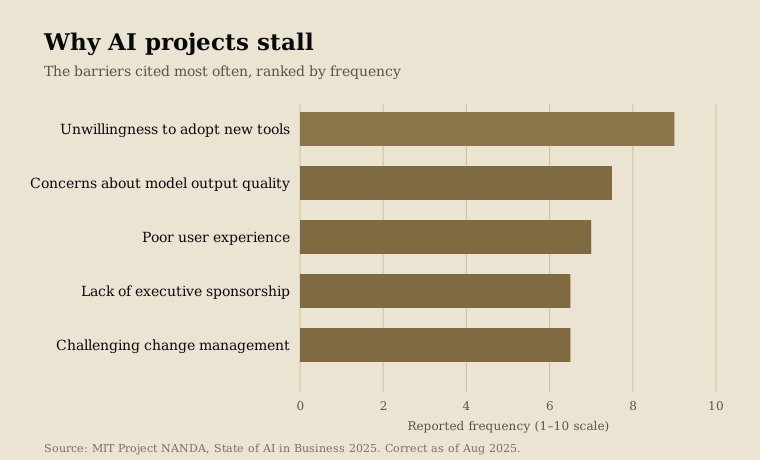
| Rank | Barrier to scaling AI |
|---|---|
| 1 | Unwillingness to adopt new tools |
| 2 | Concerns about model output quality |
| 3 | Poor user experience |
| 4 | Lack of executive sponsorship |
| 5 | Challenging change management |
Source: MIT Project NANDA, State of AI in Business 2025 (correct as of August 2025). Barriers rated on a 1–10 frequency scale.
The list is striking for what sits at the top. With the single exception of output quality, every leading barrier, the resistance to new tools, the poor experience of them, the missing executive backing, the change itself, is about people and how they took to the technology rather than the technology itself.
There is a quiet irony in the ranking, too. The barrier actually labelled 'change management' was rated the joint-lowest of the five, level with the lack of executive sponsorship, even though the obstacles rated above it, the reluctance to adopt and the poor experience of the tools, are change-management problems wearing different clothes. The firms struggling most with AI are often the ones least likely to call it a change-management problem at all.
The part that actually decides it: hearts and minds
This is the part I care about most, partly because it gets skipped so often and partly because of two decades spent in the public sector watching change succeed or fail on this exact point, long before AI arrived.
Introducing AI into a business is a change management exercise before it is anything else. It asks people to do familiar work in unfamiliar ways, and how they feel about that is not a soft detail to be tidied up later. Someone who has a tool dropped on them, with the unspoken hint that it might replace them before long, will be cautious at best. Someone who is brought into the conversation early, asked what slows their work down, and shown how the tool takes the tedious part off their plate, will usually meet it halfway.
That means doing the human work alongside the technical work: understanding how a change will land on the people living with it, listening to their concerns rather than managing them away, and helping them through the learning curve instead of expecting fluency overnight. It also has to be visible from the top, because the research is consistent that when leaders and managers won't use these tools themselves or speak positively about them, the expected returns don't materialise. People take their lead from what their managers actually do, far more than from anything written in a policy.
(On policy… I'll save data management and GDPR/ICO for another time, because that's a world of pain all of its own!)
None of this is unique to AI; it is the ordinary discipline of helping people through change, which most businesses should know how to do when they remember to reach for it. What AI changes is the stakes, because the gap between a tool that has been paid for and one that is genuinely used has rarely been this wide.
How do you measure AI adoption?
The other half of doing this well is being honest about whether it is working, which means measuring it. A surprising number of AI rollouts have no answer to a simple question: are people actually using this, and what are they getting from it? A subscription count tells you very little, since one that sits untouched costs the same as one quietly transforming someone's week. Real adoption shows up in usage, and usage can be treated like any other business measure: decide what good use looks like for a given team, make it a KPI you genuinely keep an eye on, and set it against the outcomes it was meant to improve, whether that is time saved, cost taken out, or work that now gets done that didn't before.
This is usually where my own work with a business begins, and it tends to start before the tooling rather than after it. The first task is mapping how the work actually gets done today, in enough detail to tell apart a process that should simply be sped up from one that ought to be redesigned or retired. Buying a faster version of a broken process only reaches the wrong answer sooner, which is why the mapping, dull as it sounds, is usually where the return comes from: it turns a vague ambition to use AI into a specific change you can measure against.
Paying for AI was the easy part
If your AI subscriptions are quietly costing money without changing much, the problem is unlikely to be the tools and the answer is unlikely to be more of them. The work that makes the difference is the work around them: deciding what you are genuinely trying to fix, involving the people who will have to do things differently, helping them through it, and keeping an honest eye on whether they are using it and what it gives back. That is a change project that happens to involve software rather than a software project, and the businesses pulling ahead are simply the ones treating it that way.
For a smaller, more agile business there is real opportunity in that, because most of what separates the firms getting genuine value from AI from those simply paying for it comes down to attention and a willingness to bring people with them, rather than budget or technology. That is well within reach of an SME, and it leads to the things that justify the spend in the first place: more revenue, lower costs, and time handed back to the people who do the work.
Paying for AI was the easy part. What you do in the weeks and months after is what decides whether it was worth the money.
Common questions
Is paying for an AI subscription enough to get value from it? No. A subscription gives people access, not adoption. The value comes from the work around it: a clear problem to solve, proper training, and changing how the work actually gets done. Without that, the tool tends to sit largely unused while the cost keeps going out.
Why do most AI projects fail to deliver a return? Rarely because of the technology. A 2025 MIT study found around 95% of organisations saw no measurable return on their generative-AI investment, and the common thread is poor adoption: tools introduced with no training, no clear use case, and nothing concrete to measure against.
What does good AI adoption actually involve? Treating it as a change project rather than a software purchase. Involving the people who will have to work differently, helping them through the change, securing visible buy-in from leaders, and tracking real usage against the outcomes it was meant to improve.
How should a small business measure AI adoption? Make usage a KPI you actually review. Decide what good use looks like for each team, track whether people are genuinely using the tools, and set that against the outcomes that matter: time saved, costs cut, and revenue gained.
John Sherlock is the founder of Sherlock Intelligence and a fractional CTO for SMEs, helping smaller businesses adopt AI with a change-management-first approach drawn from two decades in business change.